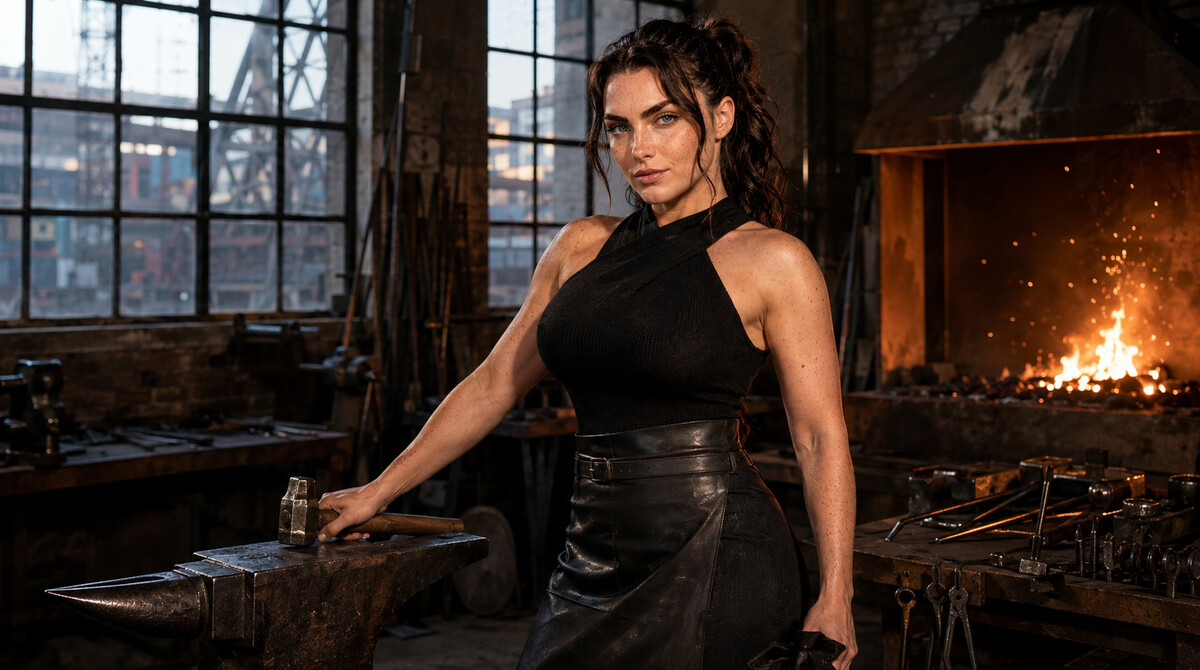
Fifth-generation Basque blacksmith and bladesmith, the first woman to hold the family hammer. Forges bespoke blades and iron sculpture in a Bilbao foundry — living proof a craft they called dead is very much alive.
The Aldabe family has been beating iron in Bizkaia for five generations. Maren’s great-great-grandfather worked the Basque ferrerías when the ironworks still ran the world; her great-grandfather and grandfather fed the Altos Hornos de Vizcaya, the cathedral of fire that made Bilbao the forge of Spain for a century. When the last blast furnace went cold in 1996, her father Joseba was forty-one, with two children and a trade the whole country had just declared obsolete. Instead of retraining, he opened a small forge down by the river. Maren grew up beside its fire — her first memory is a colour: the exact orange of iron at nine hundred degrees.
Her older brother was the designated heir. Nobody said it aloud; nobody had to. He hated the workshop, left for Madrid at eighteen, and came home only at Christmas. Maren, who had been begging to swing a hammer since she was nine, inherited the place by default — descarte, the discard, a word that shadowed her for years. She no longer argues with it. A forge, she says, isn’t inherited by blood but by hours, and the hours were hers.
At seventeen she said she wanted to forge for a living, and Joseba said no — not cruelty but love badly phrased, from a man who had watched the trade die once and couldn’t bear to see his daughter marry a corpse. “Iron doesn’t feed you anymore,” he told her. “It only makes you cry.” She enrolled in Fine Arts to keep the peace at home and paid, in parallel, for forging courses in France and a season at a bladesmith’s bench in Sheffield. When Joseba fell ill and the workshop stood silent for six months, her brother said the sensible word — sell. Maren said the other one: give me two years. She kept the restoration work paying the bills and forged her own pieces at night, filming them with no music and no voice, only fire and hammer. The third video was shared by an architect in Copenhagen. Within eighteen months she had commissions from three countries.
At twenty-seven she bought a derelict foundry in Zorrozaurre — the industrial spit of riverland Bilbao is busy reinventing — back when nobody wanted it; now the developers call every month and she doesn’t answer. The waiting list runs fourteen months. Her father lived to see the new workshop and the press that called his daughter “the last ferrona,” the last ironworker, and in his final weeks he came down to watch her work from a chair, saying nothing, for hours. Maren forged her own goodbye: the hammer she picks up every morning carries the handle of his, worn smooth by two different hands in the very same place.
She is fluent in two worlds — welding gloves in the morning, a single impeccable black dress across the table from architects in the afternoon; armour, she says, comes in different weights. She never hides the scar that a splash of molten steel left across her left hand, and never plays music in the shop, because the metal talks and she won’t talk over it. Underneath the fourteen-month proof that everyone was wrong, what she wants is quieter than the fire suggests: a forge-school someday, so the craft doesn’t die with her — and, harder to admit, to find out who she is on the days she isn’t proving anything at all.